Introduction
At the end of last year,
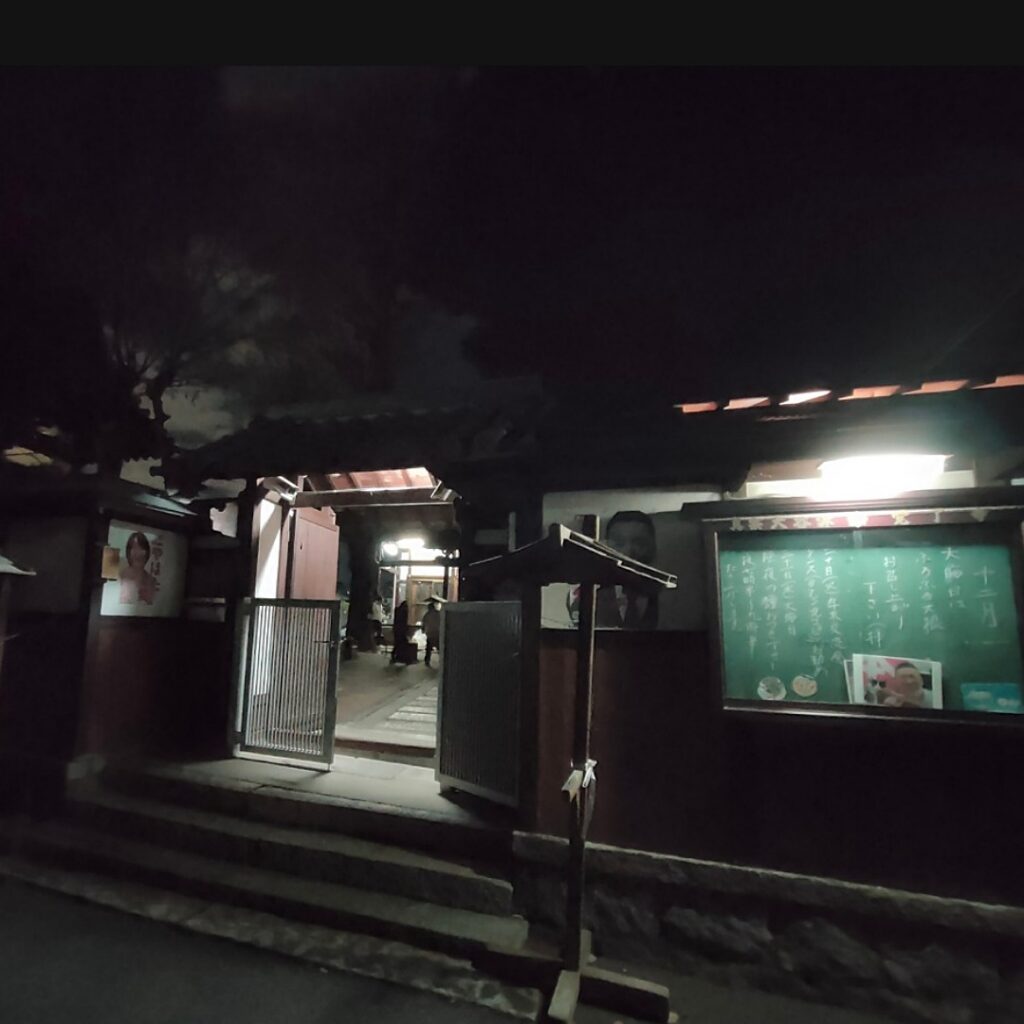
we went to Kakuryoji Temple to ring the New Year’s Eve bell.
These days, some people feel that the sound of temple bells is too loud,
so many temples adjust the time to be more considerate of the neighborhood.
Kakuryoji Temple does the same.
When I was little, I remember hearing the calm,
soothing sound of
“Goooon… Goooon…” starting around 11:30 p.m.
As I grew older and moved to different places,
I gradually lost the chance to hear it.
This blog post contains some affiliate links.
Actually Ringing the Bell at Kakuryoji Temple
This time, the temple rang the bell at a neighborhood-friendly time,
from 7:30 p.m. to 9:30 p.m.
We heard that not only could visitors ring the New Year’s Eve bell,
but they would also be served
furofuki daikon (simmered daikon radish).
So we decided to visit,
hoping it would be a meaningful experience for our child as well.
We visited not only for ourselves, but also so our child could experience this tradition.
The owner of Bukubuku-tei, a fugu restaurant in Ebatamachi,
Kadoma City,
kindly made furofuki daikon and kasujiru for us.
With the help of several other people preparing things around us,
we were able to ring the bell right away.
The dishes were kindly prepared by the owner of Bukubuku-tei,
a fugu (pufferfish) restaurant in Ebatamachi, Kadoma City.
You can find Bukubuku-tei on Instagram here:
https://www.instagram.com/bukubuku_tei/
I’m not sure if the owner speaks English,
but if you can communicate in Japanese,
you’ll be able to enjoy chatting with him.
It’s a local restaurant known for its fugu cuisine
and warmly supported by the community.
As of now, Bukubuku-tei is a casual fugu (pufferfish) restaurant
that opened on March 4, 2024.
They also run community activities such as:
– A children’s cafeteria held on the last Sunday of each month
– A homework café held every Wednesday
Business hours: 5:00 PM – 10:00 PM
Closed on Tuesdays
Address:
11-1 Higashi-Ebata-cho, Kadoma City, Osaka
Phone:
090-3262-8111
Instagram:
@bukubukutei
Thanks to them, we were able to ring the bell right away.
Since it was my child’s first time,
we rang the bell together.
The sound—
Gooooooon…
was much deeper and more powerful than I expected.
It resonated through my body,
and I honestly felt as if negative energy had been cleared away.
For a child, this is not an experience you get very often,
and it reminded me how important it is
to cherish and pass down traditional Japanese events like this.
When Is the Bell Rung?
Traditionally,
- The first 107 rings are done during the old year
(December 31)
To drive away all worldly desires accumulated over the past year,
the bell usually starts ringing late on New Year’s Eve
(around 11:00–11:30 p.m.),
and the first 107 rings are completed before the year ends. - The final ring (the 108th) is rung in the new year (January 1)
With the wish to begin the new year free from worldly desires,
the final 108th ring is traditionally struck exactly at midnight,
the moment the New Year begins.
Why “108 Rings”?
This is a well-known explanation,
but in Buddhism, it is said that humans have 108 worldly desires,
known as bonnō (mental distractions and attachments).
Each ring of the bell is believed to cleanse one of these desires,
helping people welcome the New Year with a purified mind.
However, Rengetsu, the head priest of Kakuryoji Temple, says
that this idea is more of a common belief.
She teaches that bonnō cannot be reduced or erased,
but should be recognized and faced within ourselves.
Since there weren’t many people around,
and thanks to the kind generosity of the monks,
they said,
“You can ring it more if you like!”
So our child was allowed to ring the bell,
taking turns with the other little kids.
Can you hear it?
“One, two, three…”
But instead of gong,
it kept going
“One, two, three, four, five…”
At that point I thought,
“When is it actually going to ring? (lol)”
So I cut the video…
but then—surprisingly—
it rang twice in a row,
and our child was still trying to ring it again ( ゚Д゚)
(I had to stop them in a hurry,
so that part is left out—lol)
The warm and gentle kindness of the monks at Kakuryoji Temple
really made my heart feel soft and happy.
After ringing the bell,
we were treated to the much-anticipated furofuki daikon
and kasu-jiru
(probably made with sea bream stock).
I forgot to turn on the light,
and I hesitated to take photos because of the location,
so by the time I asked for permission…
the furofuki daikon was almost completely gone ((+_+))
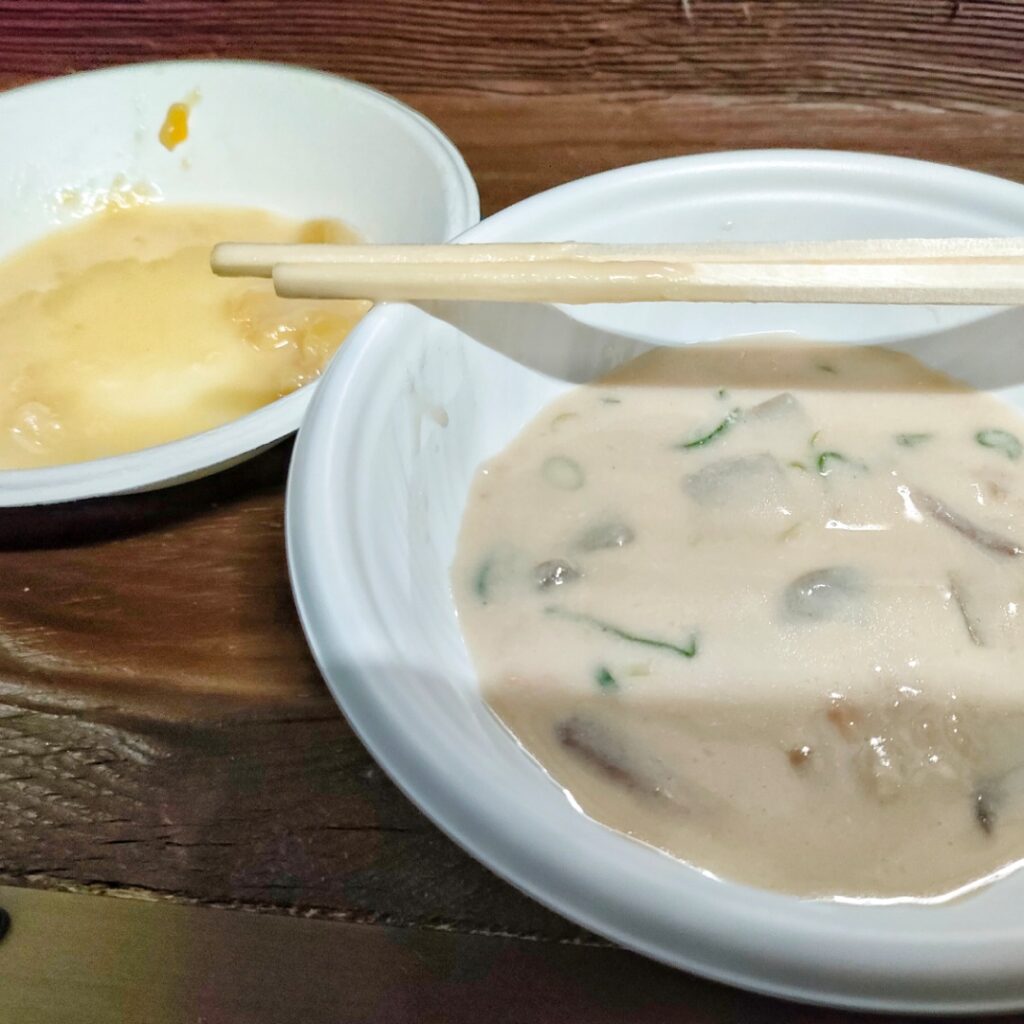
I don’t usually order kasu-jiru,
but this one was clearly made by someone
with amazing cooking skills.
It had a gentle sweetness,
deep richness,
and the aroma of sea bream softly passed through my nose,
bringing a sense of happiness to my mind.
It soaked into my cold body
and became such a comforting, relaxing moment.
Thank you so much for the wonderful meal
Otakiage (Sacred Burning Ritual)
One more thing took place in the cold weather.
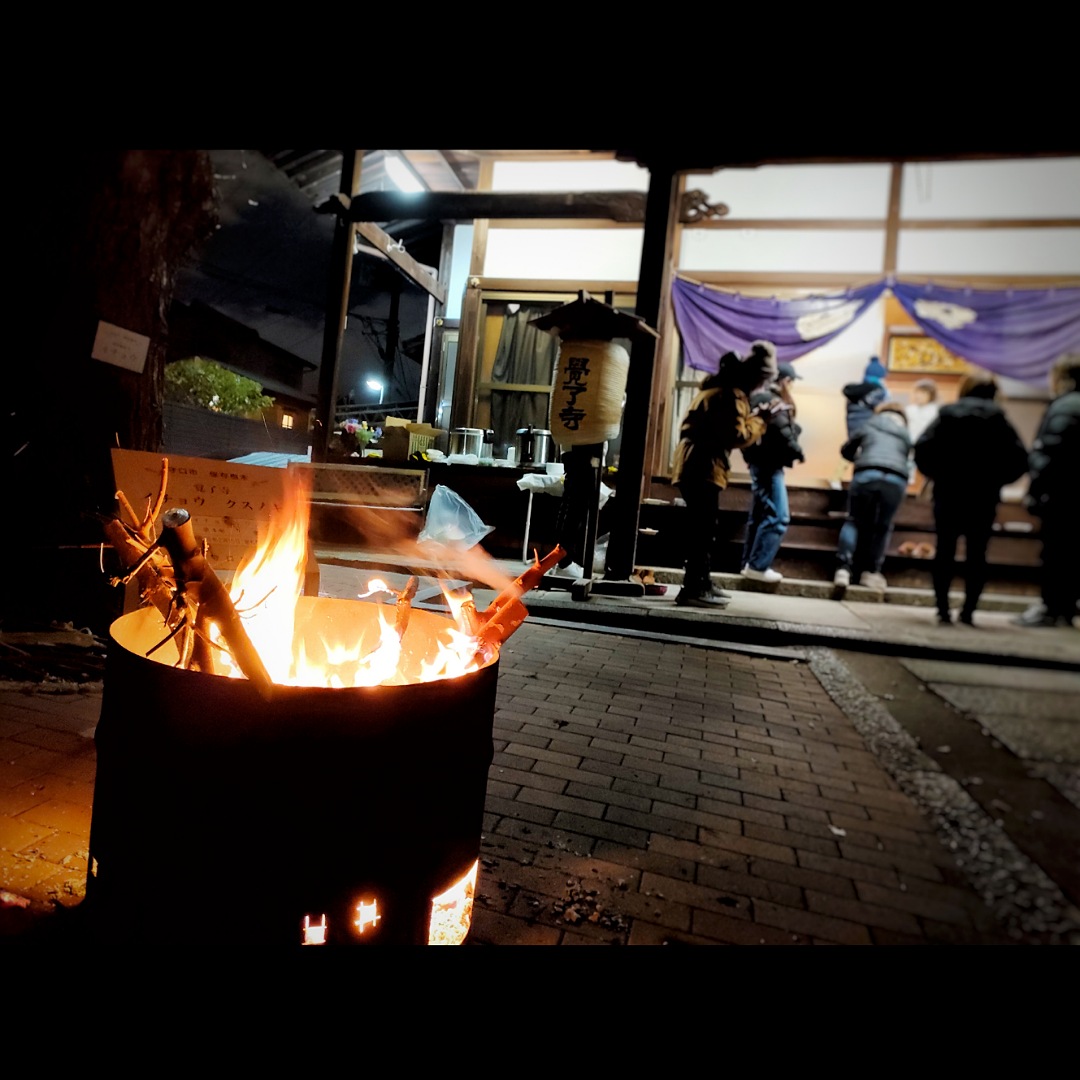
Flames lighting up the dark night—
a ritual to purify bonnō (worldly desires)
and kegare (impurities).
When the fire was about to go out,
more wood was added to keep the flame alive,
and so were our feelings.
(It almost went out once, actually—lol)
Thanks to that,
we were able to spend a warm and peaceful time.
A Cat–Friendly Temple — Kakuryoji
Kakuryoji Temple is also known as a cat-friendly temple.
Within the grounds, there are a camphor tree and a ginkgo tree,
and the temple has become well known for being kind to cats.
The temple’s name is Kakuryoji,
and you’ll find small cat ornaments placed around the grounds.
Although we didn’t see them directly,
it seems that rescued cats are also being cared for here.
Now, let me introduce the monk of the temple
About the Head Monk
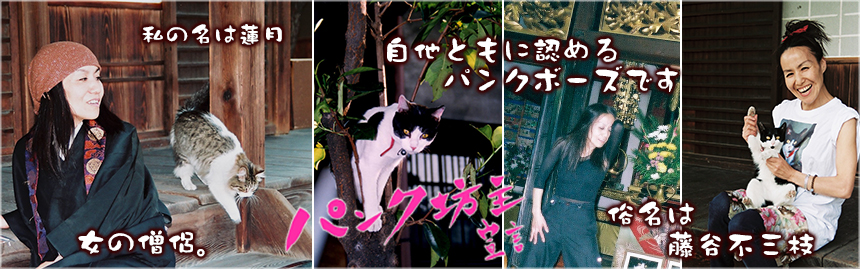
There is a reason behind the red stole worn above.
Kakuryoji is a temple that supports animal welfare
and provides a place of acceptance for minority communities.
The head monk is a female priest of the Otani-ha sect of Jodo Shinshu,
and she is known—by herself and others—as a true “punk monk”
Her name is Rengetsu.
Is it okay to say she’s a little unique?
Honestly, she’s someone you rarely see elsewhere—
at least, that was my first impression.
This is just my personal observation (´▽`), but…
She seems gentle, yet firmly grounded,
the kind of person who speaks clearly and directly—
whether it’s something good or something difficult.
I imagine she has a refreshingly straightforward personality
The Dancing Monk
Interestingly, she also loves dance.
She’s even known as a “dancing monk.”
At memorial services and events,
she reportedly performs Michael Jackson–style dances,
which has made her very popular and approachable.
Basic Information
Name: Jitozan Kakuryoji Temple
Address: 4-6-9 Hashibahigashino-cho, Moriguchi City, Osaka
(3 minutes on foot from Nishisanso Station)
Official Website: ↑Click the photo to learn more on the official website.
If you’re curious, feel free to take a look
Recently, most updates seem to be shared on Facebook,
and the website itself appears to be no longer actively updated.
For Those Curious About the Dance
For those who are curious about what kind of dance it is,
I’ll leave the video here.
“This is ‘Who’ by Jimin of BTS — and the monk is playfully dancing along ♪”
This video has been posted with permission,
granted through the monk and the dancer involved.
I personally love dancing too,
but I’ve never had the confidence to dance so freely in front of others…
I truly admire how the monk can dance so boldly and confidently.
I’d love to have a heart like that someday.
So inspiring! (^^)/~~~
A Book by the Punk Monk
It seems that she has also published a book titled
“Punk Monk Declaration.”
The cover photo—showing her impressive flexibility—is wonderful.


↑Click the photo to view it available on Amazon Japan.
A Temple That Feels Open
To be honest,
I used to have a rather rigid and formal image of temples.
But this place felt different.
Even first-time visitors are naturally
welcomed and accepted,
as if the air itself is gently embracing you.
That feeling stayed with me. (^^)
Final Thoughts
The year-end and New Year period always feels so busy,
passing by in the blink of an eye.
But spending time like this—
pausing for a moment and reflecting on the year—
reminded me how important that can be.
If you’re thinking,
“I want to visit an interesting and unique temple!”
I highly recommend stopping by Kakuryoji Temple someday.
(^^)/~~~
Check out my blog Japanese version post here.
Check out my previous blog post here.



コメント